
Applicable requirements
Identify destination law, machine category, customer specifications, utility rules and relevant standards.
Standards & responsibility
A transparent map of applicable requirements, evidence, customer responsibilities and limits of workshop verification.
Request technical reviewThe applicable standard set depends on the machine, assembly, destination and customer specification. Referencing IEC 60204-1, IEC 61439, IEC 61800-5-1 or IEC 60529 does not itself prove certification or project compliance.
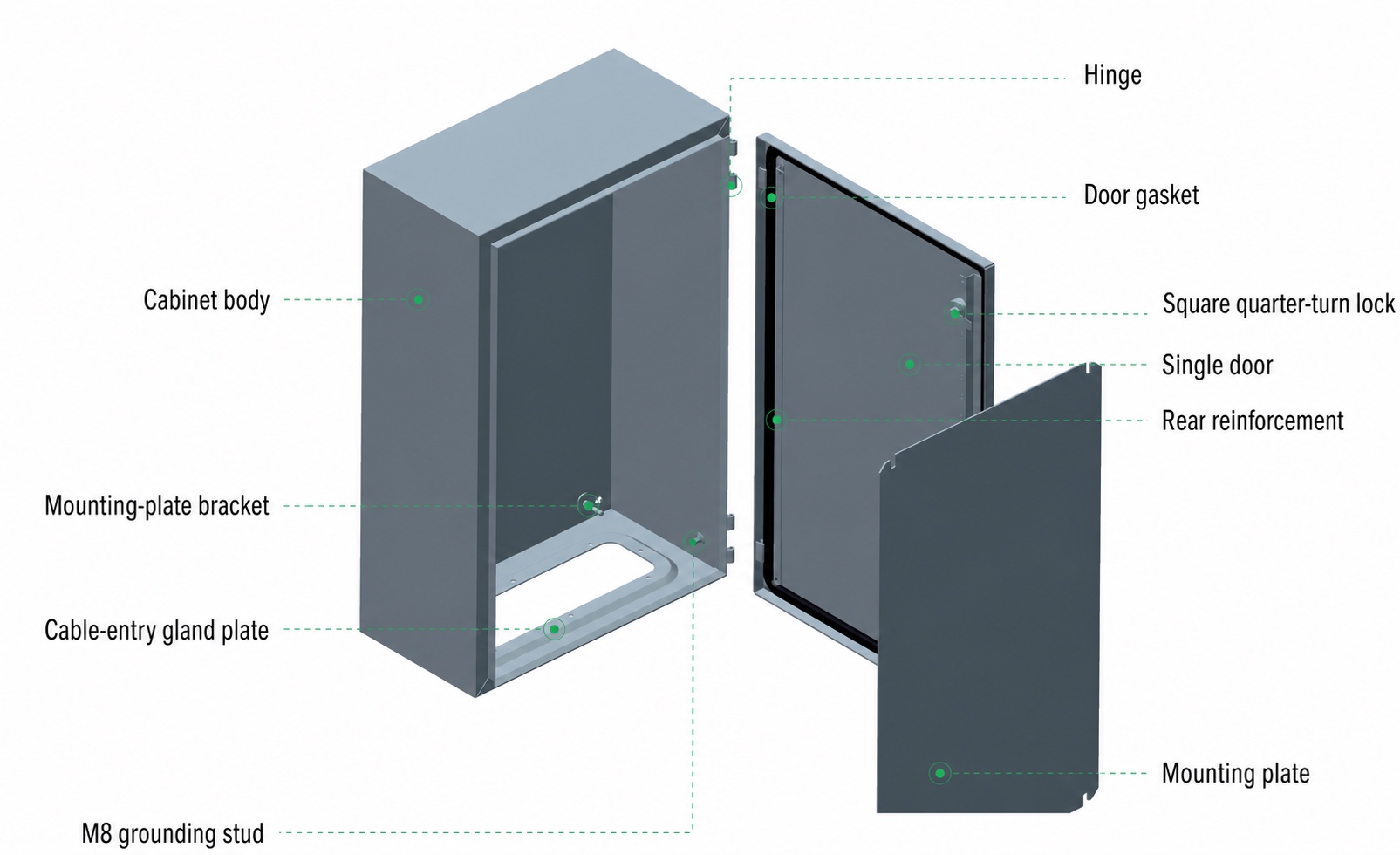
Material, construction, protection and installed devices must be evaluated as one assembly. A standard reference is not a certificate by itself.
Engineering decision framework
For standards, verification and scope boundaries, the quotation and technical response should address applicable requirements, iec 60204-1, iec 61439 and the remaining project boundary. Missing inputs are recorded as assumptions before selection or design release.
Identify destination law, machine category, customer specifications, utility rules and relevant standards.
May inform machine electrical equipment; applicability and the boundary from supply connection to machine must be confirmed.
May inform low-voltage assembly design and verification; the required assembly scope and evidence must be defined.
IEC 61800-5-1 and IEC 60529 may inform drive safety and IP classification, but installation determines final performance.
Separate customer, Honghao, machine builder, software, safety and site responsibilities in the quotation.
Workshop FAT, site acceptance and final machine validation prove different things and require separate plans.
Planning input
Compliance language is used only when the agreed evidence supports it.
Common buyer questions
These answers cover the questions buyers usually ask when evaluating standards, verification and scope boundaries. Final product identity, ratings and deliverables are still verified against the complete article number and agreed project data.
No. A standard reference describes a technical basis only. Certification, conformity assessment and project compliance require the applicable scope and supporting evidence.
The responsibility must be defined contractually. Panel supply or PLC programming alone does not replace the machine risk assessment and final functional-safety validation.
FAT checks agreed workshop-available evidence. SAT checks installation and functions with field equipment at site. Final process and safety validation may go beyond both.
Yes when they are identified early, supplied in usable form and included in the agreed design, procurement, verification and documentation scope.
Workshop review and FAT do not replace machine risk assessment, final site wiring verification, process commissioning, local authority acceptance or functional-safety validation unless these items are separately contracted and documented.
Define the engineering scope