
Load and supply
Record voltage, frequency, phases, earthing, current, diversity, inrush, duty and future capacity.
Electrical & enclosure design
A design-basis workflow for load, protection, thermal, EMC, control power, enclosure and environmental decisions.
Request technical reviewIndustrial control panel design begins with electrical load, supply, environment, interfaces and service conditions. The enclosure and product list are outputs of those decisions, not fixed starting points.
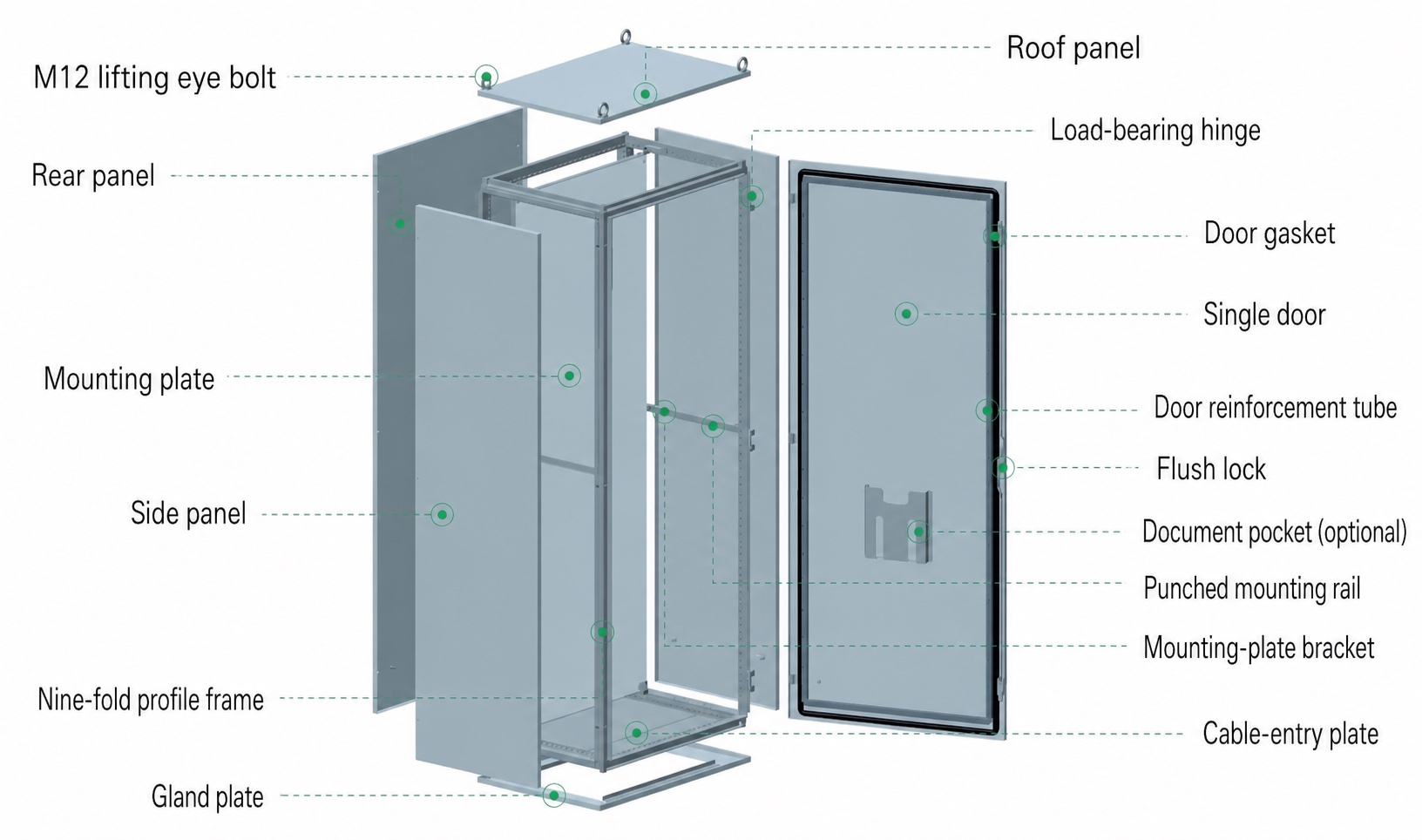
External dimensions are only one layer. Usable mounting area, clearances, cable entry, thermal method and service access are approved together.
Engineering decision framework
For control panel engineering, the quotation and technical response should address load and supply, protection basis, thermal balance and the remaining project boundary. Missing inputs are recorded as assumptions before selection or design release.
Record voltage, frequency, phases, earthing, current, diversity, inrush, duty and future capacity.
Define isolation, branch protection, motor protection, coordination intent and available short-circuit information.
Compile losses and check ambient, altitude, enclosure rating, airflow, cooling, dust and maintenance access.
Plan segregation, protective bonding, shield termination, drive cable routing and sensitive signal paths.
Calculate continuous load and inrush, then review reserve, selectivity, redundancy, UPS and diagnostics.
Check clearances, ducts, terminals, cable entry, HMI access, replacement space, lifting and transport restraints.
Planning input
Missing data is recorded as an assumption before the panel is released.
Common buyer questions
These answers cover the questions buyers usually ask when evaluating control panel engineering. Final product identity, ratings and deliverables are still verified against the complete article number and agreed project data.
Use real equipment dimensions, manufacturer clearances, wiring space, thermal losses, cable bend radius, service access and spare capacity—not a preferred cabinet size alone.
No. A sealed enclosure can make thermal control harder. The required protection and the cooling method must be evaluated together.
It affects protective-device selection, coordination and the assembly design basis. Unknown fault data should be listed as an unresolved project input.
Customer specifications can be included when supplied and reviewed. The quotation should state applicable documents, deviations and verification responsibilities.
Workshop review and FAT do not replace machine risk assessment, final site wiring verification, process commissioning, local authority acceptance or functional-safety validation unless these items are separately contracted and documented.
Define the engineering scope